
Tidelines – August 2025
About once a year I get in the position where I’m facing our newspaper’s print deadline and I need a quick fishing trip to write about for my Tidelines column. July saw numerous offshore trips postponed due to wind and waves, so with just two days until layout, I made a call to Capt. Pierre Agena of Rising Sun Fishing Charters operating out of Wrightsville Beach.
Luckily for me, Pierre had Saturday free because he wanted to take a late-July mental health day after running almost 30 days in a row.
Could I meet him at the Wrightsville Beach public boat ramp a little before 6:00 am to head out for a quick topwater bite and be back to the docks around 9:00 am?
Yes. The answer was a definite yes.
Redfish is probably the number one summer target in the Wrightsville Beach area, especially with a spanish bite that’s been lackluster most of the season, and with a hot and bright summer sun, the July-August topwater action is basically only a morning bite.
“If you’ve got a good tide in the morning where you don’t have flooded grass so you can reach the redfish, early morning is definitely worth checking out any of your spots with topwaters,” Pierre explained as we headed south down the ICW, checking the tide to see if he had enough water to go over a sandbar on plane that separated a dozen or so docks from the ICW, “and depending on the tide, 8:30 is usually my random number I throw out there to stop topwaters.”
On our morning, 6:00 am was the low end of an incoming tide, and we pulled up to a series of docks, some tight together and some not. Using the trolling motor to move just outside the opening between the first two sets of docks, Pierre pushed a Stick-It anchor in to avoid the noise of setting his twin Power-Poles. We were holding in water less than two-feet deep and would be casting to water less than one-foot deep.
He handed me a One Knocker Spook and had another rod with a Rapala Skitter Walk ready just in case.
“I like the One Knocker Spook,” he answered when I asked what he most liked to throw, “because it’s very user friendly. It has an easier movement through the water that gives newcomers to topwaters a lot more left to right action.”
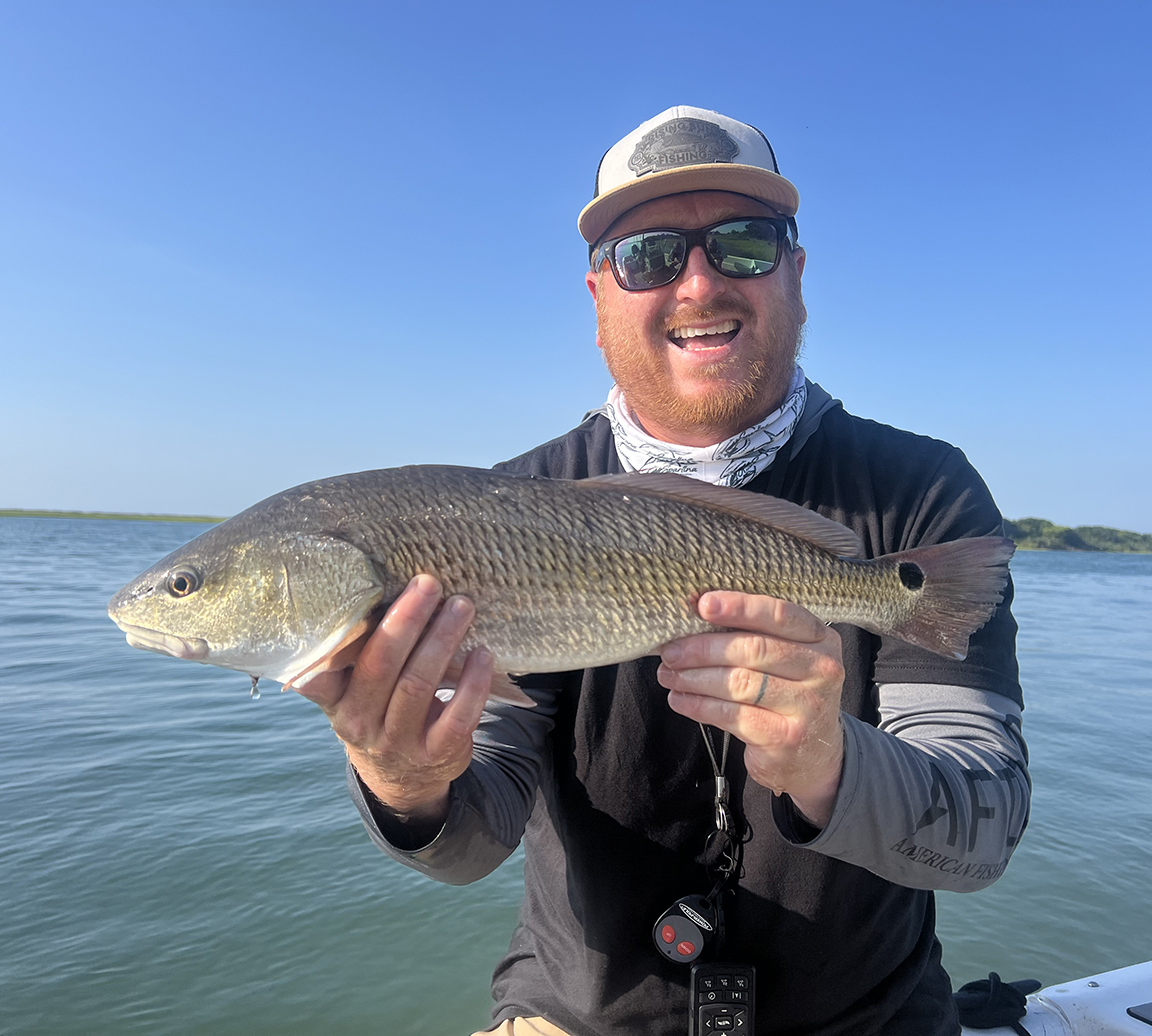
Pierre’s approach was methodical. He had docks in this section where he typically found more summer redfish than on other docks, but he wanted to cover all the docks in this section until we found fish. He emphasized, though, that a lot of topwater fishing is visual.
“Use your eyes,” Pierre told me. “Try not to rely on making a thousand casts. Try to put eyes on fish or bait. Try to put eyes on movement. Use your eyes to make your casts a little more targeted.”
I saw movement up ahead, but Pierre explained that what I saw was larger mullet. This was evident, he continued, from the more linear movements that mullets make, and then we saw between the next set of docks a big blowup by some oyster rocks just off a grassline. The area of that aggressive feeding action would be the target of my next cast.
I put my topwater as close to the shoreline as possible, brought the lure back through the area of the activity with a steady cadence, and quickly had my first blowup of the day. The topwater completely disappeared underwater, but the hook never came tight.
A missed blowup is common in the world of topwaters, especially when throwing topwaters for red drum in the heat of summer where they may be a little lethargic even in the early morning hours.
I got ready to cast again and Pierre reminded me of the basics, “It’s really important to keep your cadence, even when you do get a blowup. A lot of times they’re going to miss it the first time. Just keep your cadence. Don’t swing at it. Don’t try to set the hook. And if you miss, you tend to get another shot.”
I asked if I should throw my topwater to the same location and retrieve my topwater in the same line that just created that blowup.
“Very rarely will I make the same cast in a row,” he explained. “I like to vary my casts even if it is just 5-feet to the left or 5-feet to the right.”
I covered the area with multiple casts, and even had the advantage of the fish showing itself by crashing bait on the shoreline down to the right and then again a little off a half-submerged crab trap, but we couldn’t get another blowup.
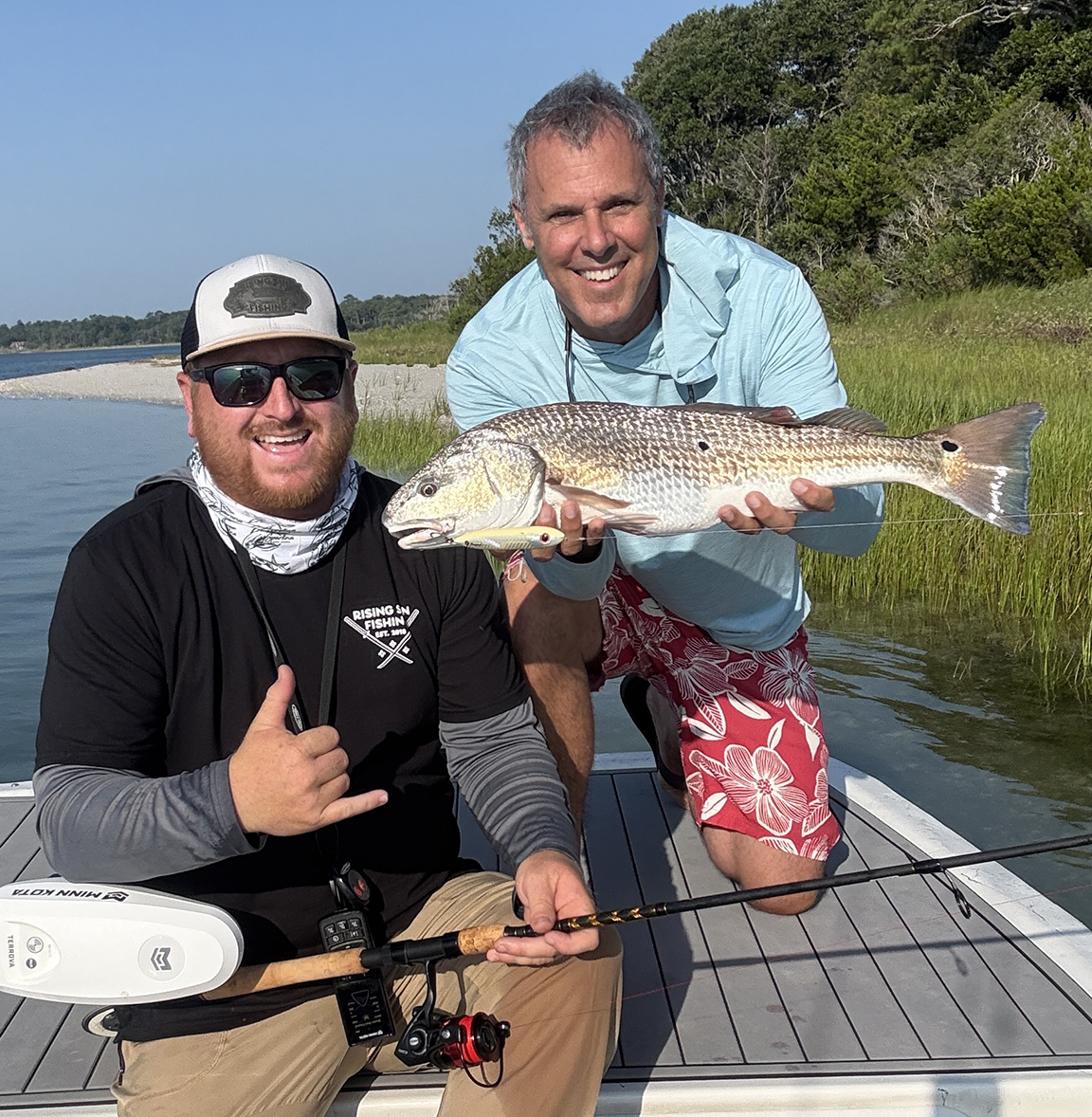
Pierre kept moving down the line of docks, and during our search, I kept asking Pierre questions.
What advice do you give clients to help them cast a topwater as far as they need to?
“The biggest tip is to leave the leader out of your guides. Keep your uni-to-uni knot from going past the tip of the rod.”
How do you set the drag?
“You want the fish to be able to run as soon as they hit the bait.”
What’s the best way to fight the fish if you get a hookup?
“Don’t put a lot of pressure on the rod tip. The angle of their mouth is downward, so when they’re striking that lure, they’re trying to come over the top of it. They’re often getting the hook in a weird spot.”
We were now between two sets of docks with a long, uninterrupted grassline separating them. Pierre had me start with the dock to our left. My first cast hit the corner of where the dock meets the grassline, and then I started covering water by making each subsequent cast about five feet to the right. On the fourth cast, I finally had a blow up that came tight. I felt the weight of the fish, gave a little bit of a hook set, and then reeled quickly because the fish was now swimming away from the shoreline and toward us.
Pierre waited through several last minute drag pulls by the side of the boat before reaching over to get my first topwater fish of the day into the landing net. Pierre had done it. We would go on to hook other red drum between these and other docks, but all I truly needed was this one good fish to have a Tidelines article for the August issue.
If you’re looking for good drag pulls (and a couple of nice fillets) in the hottest part of the summer, then redfish are likely the answer, and if you’re wanting to catch your summer redfish in perhaps the most fun and exciting way, then early morning topwaters is also the answer.
Finally, if you want to enjoy that experience and make those memories in the Wrightsville Beach area, then call on Capt. Pierre Agena of Rising Sun Fishing Charters. He will be targeting redfish through the summer and into the fall from south Topsail all the way down to Carolina Beach.
Pierre can pull out the popping corks and bait (both live and cut) to stay on the bite throughout the day, but I predict that the topwater action, both the blowups that come tight and the ones that don’t, will be the first stories you tell.
