
Tidelines – April 2026
Capt. Bevan Hunter, of Chilly Water Fishing, had wanted to meet at the Murrells Inlet public boat ramp an hour earlier at 4:00 am so that we could be at the Winyah Scarp by daylight, but 5:00 was the best I could do with a two-hour drive and my son James not even getting off work until 11:00 pm the evening before.
Bevan shares his charter time between Murrells Inlet and Little River, and he chose Murrells Inlet on our day because of the shorter boat ride and the water looked better to the south. The plan was to high-speed troll the area in search of wahoo and blackfin tuna.
“High speed trolling let’s me map the area out,” Bevan told me while grabbing a lure bag out of a back hatch, meanwhile James laid fast asleep in one of the bean bags. “I try to figure out where the fish are. I try to see where the bait is, see what the water temperatures are doing, and see if there’s going to be a lot of weeds to navigate around. High speed allows me to cover a lot of ground really quickly.”
His standard high speed trolling spread is five lines: one long shotgun line and then four lines with varied trolling weights. The heavier trolling weights (32 oz. and 48 oz.) go closer to the boat, and the lighter ones (16 oz. and 24 oz.) go further back. For the shotgun line, he likes a cedar plug with no weight.
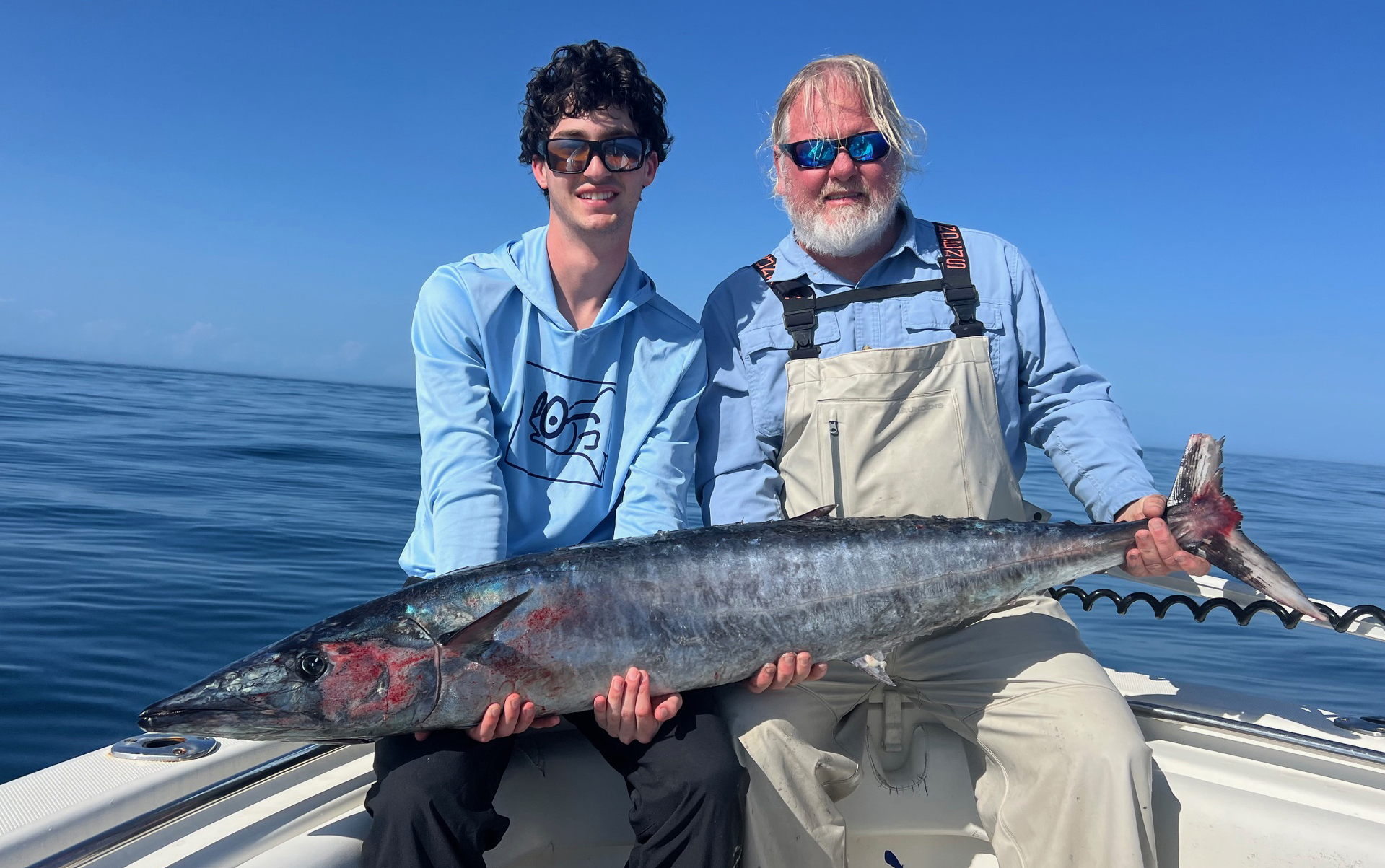
Capt. Bevan Hunter (right), of Chilly Water Fishing, poses with James Hurley and James’ first wahoo. The wahoo hit a Big Nic Big Jewel while high speed trolling at the Winyah Scarp.
The Winyah Scarp is a popular series of ledges about 51 miles out of Murrells Inlet and sitting in anywhere from 130-200’ of water. A couple of boats were already in the area when we arrived, but Bevan was most focused on the water temperature.
With a slightly confused look, he explained, “The water’s not as warm as what I was seeing yesterday on the satellite shots. Yesterday it was showing 73 degrees, and right now we are seeing 68.5 degrees.”
Bevan has the most confidence when he finds 73-74 degree water, but if the water temperature is at least over 70, he’s happy. In the search for warmer water and more confidence, we headed southerly in a zigzag coverage and kept the boat between 14-18 mph.
“The zigzag approach lets me cover the ledges and it also lets the lures sink in the column. When you turn, the lures go down,” Bevan continued as he kept one eye on his machines and another eye on the five lines.
The other boats were trolling bait, and all their talk on the radio was false albacore, amberjacks, and barracuda. Our faster pace avoided those non-desirables, and after a handful of short strikes, suddenly the cedar plug, which had been put way far back because blackfins can be a little boat shy, went off.
The bite was unexpected in that we hadn’t seen fish or birds or bait on the surface, or even good single marks on the machine. Bevan pulled in the two lines from the port side, began a slow turn in that direction, continued moving forward at no slower than 4-5 mph, and kept the fish on that same port side.
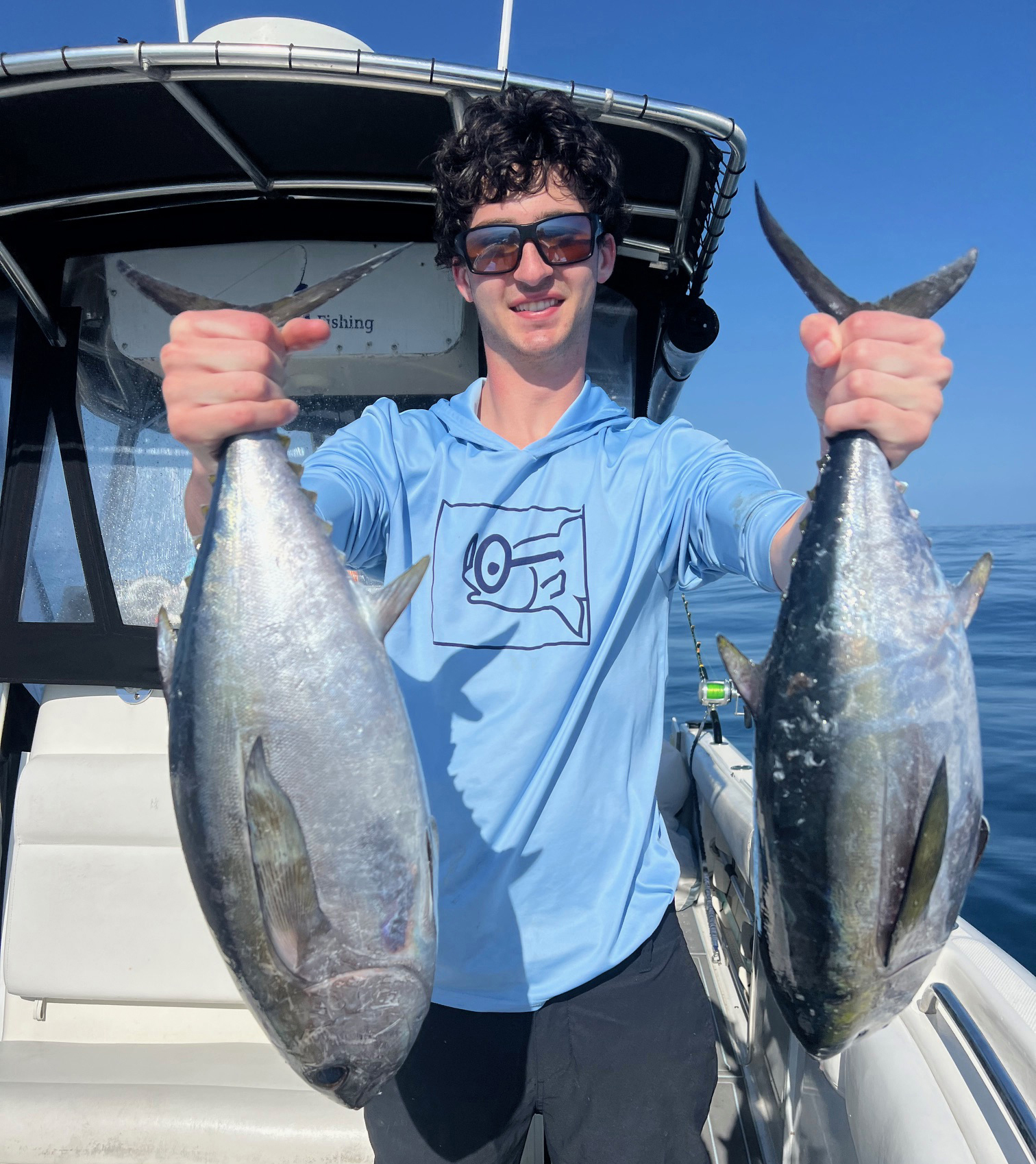
James Hurley holds up two of the blackfin tunas that hit a cedar plug on the shotgun line. He was high speed trolling in roughly 100′ of water with Capt. Bevan Hunter of Chilly Water Fishing who operates out of Little River and Murrells inlets.
With the line set way far back, James reeled for a long time, but eventually he had the swivel to the rod tip. Bevan opened the transom door, instructed James to walk the rod up to the front of the boat, and then he handlined the fish in.
“When I get a trolling bite, I’ll hit an area two or three more times and from different directions. I try to figure out why that fish was there,” Bevan told us as we celebrated James’ first blackfin while making way back to where we got that bite. “If you catch a fish, usually there’s a reason why he’s there. The idea is that there should be others in there with him.”
Back at the bite location, Bevan pointed in the 1:00 direction off the bow of the boat telling us he thought he had seen a flicker or flash of bait, and very shortly after heading that way, the shotgun line’s clicker started screaming again.
James had already found his way back to the bean bag, so I took a turn on the rod. This second fish played out just like the first—pull the two portliness, slow down but maintain enough speed to keep the two starboard lines tight and working, as well as help keep the hooked fish tight. Soon Bevan handlined our second blackfin through the transom door.
Back in the same area as the two blackfin bites, Bevan saw a compelling slick on the water’s surface. We made our way across it, and on the second or third pass, the starboard short line, pulling a Big Nic Big Jewel, starting dumping line in a hurry.
James once again arose from the bean bag and sat down immediately behind the bent butt rod and began reeling. This fish was clearly heavier than our first two fish, as well as stronger and angrier, but James played the fight correctly—being patient when the fish pulled line and taking line back every time the fish allowed.
Once the fish was close enough, Bevan saw that the hookset was good and decided that there was no need to gaff the fish, but a near 40-pound wahoo coming through the transom door acts way different than a modest blackfin. James stood with open mouth and needed a minute to process this tail flapping, boat smacking, head shaking fish that stretched across the stern.
This was not only James’ first wahoo but his biggest fish to date. We cheered, took photos, cheered some more, and then Bevan drug our wahoo to the front fish box while I hosed down the back of the boat.
March and October are Bevan’s favorite months for wahoo and blackfins, so you should think about booking an October date now. And if you don’t want to wait for the fall, then Bevan will jump at any chance to head out to the Gulf Stream, but he also likes targeting the spring nearshore sheepshead bite, which transitions into the bonito run, which precedes the arrival of spanish, which is followed closely by the bigger mahi.
Capt. Bevan Hunter, of Chilly Water Fishing, loves nearshore and offshore fishing and sharing that love and excitement with his clients. Your choice: you can take the more interactive route, or you can take the James route and sleep in the bean bag until someone wakes you up and tells you it’s your turn on the rod.
It’s an easy decision because there’s no wrong decision—just get on Bevan’s boat.
