
Tidelines – November 2026
What’s better than a long-time captain friend that you can call on when you need a fishing trip? When that captain friend not only says meet me at my house tomorrow morning but then calls up another captain friend to join us.
Capt. Mike Oppegaard, of Native Son Guide Service out of the Topsail area, loves chasing false albacore in the fall, and a false albacore trip in early October sounded perfect.
While false albacore were around and had been caught, they hadn’t yet arrived in numbers, likely due to the still higher than normal water temps. Finding fish and then getting finicky fish to bite are often the challenges when false albacore fishing, and I had a front row seat to Mike and Capt. Ray Brittain, of Spring Tide Guide Service, also out of the Topsail area, going through the process and ultimately solving the false albacore riddle.
“The bait’s small but plentiful out here,” Mike quickly noted when we stopped just outside New Topsail Inlet to take in the surroundings. “Lots of snot bait just under the surface but not much showing on the screen.”
“Not much activity on top,” Ray added. “The action is scattered, and the fish I’m seeing are all small.”
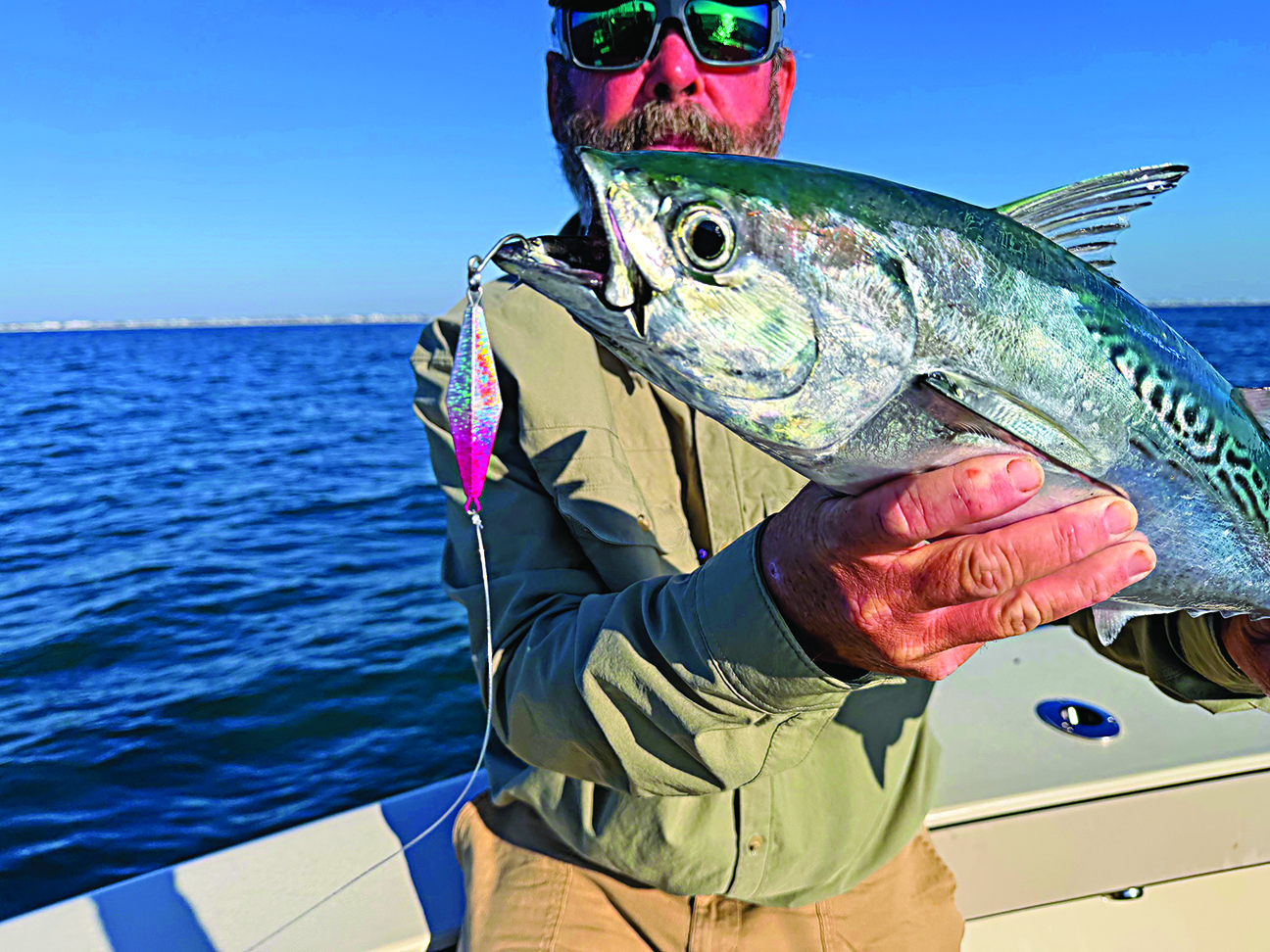
Capt. Mike Oppegaard, of Native Son Guide Service, shows the Clarkspoon 1927 diamond jig (3/4 oz.) that generated a false albacore strike on a morning out of New Topsail Inlet when the fish started out finicky.
Me? I saw the bait just under the surface but saw it after Mike had pointed it out, and I saw the scattered surface activity but it didn’t register with me that the few fish jumping were small until Ray told me they were small.
Mike put a trout rod setup in my hand, a Florida Fishing Products 1000 reel on a TFO Resolve rod, and told me to make a couple of blind casts as we neared a bar a little offshore and to the right of the inlet. A half dozen or so casts later and still nothing to get us excited led Mike to make the decision to run a little deeper and a little north, though he kept Figure Eight as an option if we didn’t find fish.
Mike was the first to see our target species, “I’m seeing a small pod up ahead, but it’s only a couple of fish and they aren’t staying up.”
We kept heading in that direction.
“There’s another small pod about 100 yards up and along this same line,” Ray noted. “So far all the fish we are seeing are right on this 40’ contour line.”
Me? I only saw the pods after Mike and Ray showed them to me, and the one school I thought I was the first to see was a school of dolphin that Mike and Ray had seen but hadn’t pointed out because they were dolphin and we were looking for false albacore.
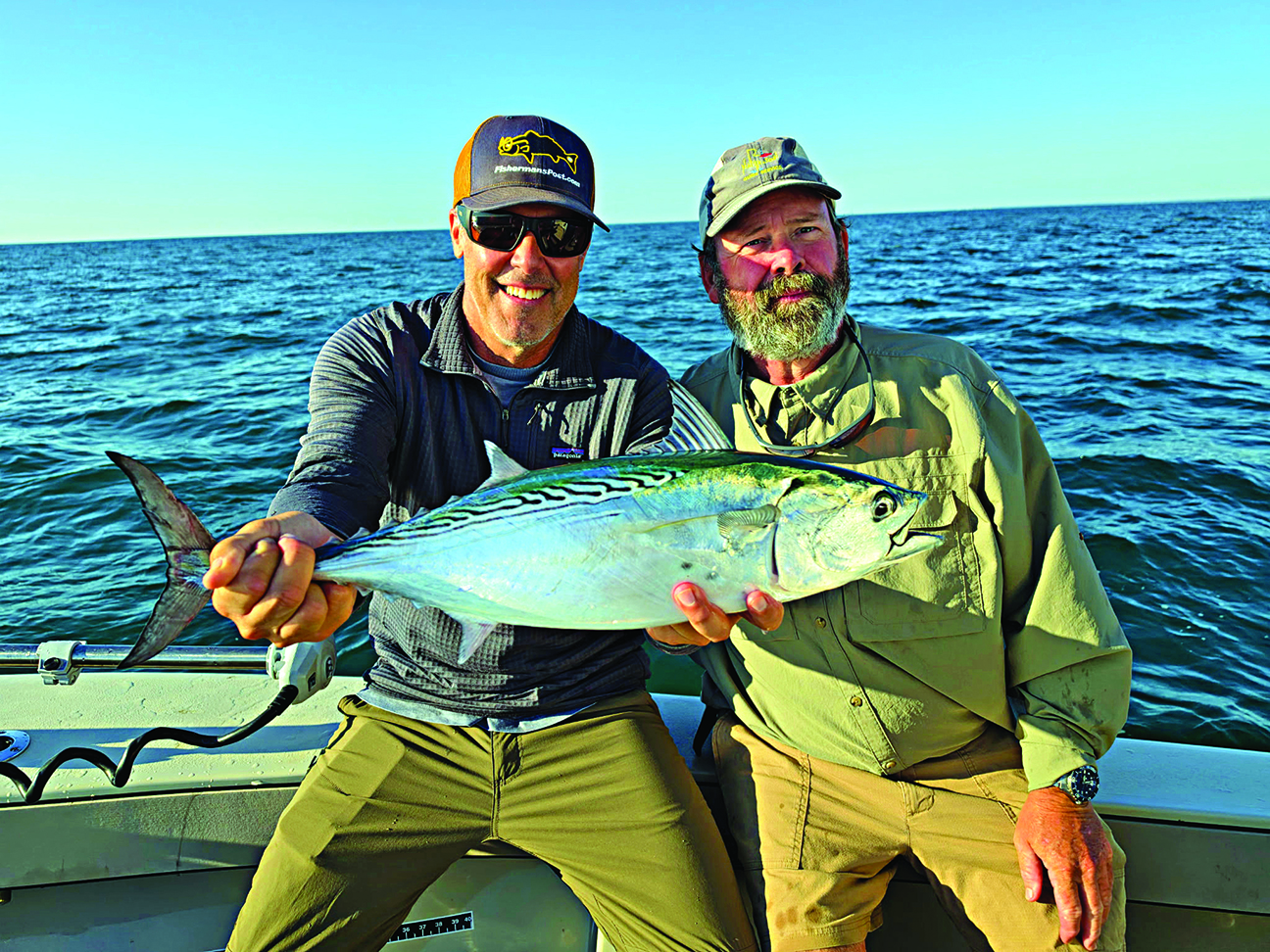
Gary Hurley (left), of Fisherman’s Post, holds up a false albacore hooked on a Clarkspoon 3/4 oz. stick jig in 40′ of water offshore of Topsail Island. He was fishing with Capt. Mike Oppegaard (right), of Native Son Guide Service.
Finally, a small school surfaced not far from the boat and in the same 40’ depth. Ray, who was driving Mike’s boat so Mike could fish, slowly turned the boat in that direction, but the fish went down before we could get the first cast to them.
“Are they spooky fish? Is the boat pushing them down? Have these fish been pressured?” were the obvious questions, and while Mike and Ray asked those questions and pondered on the possible answers, they knew we needed a larger sample size before making any conclusions.
A few more pods appeared on the surface in our vicinity, and this time we were able to get our metal jigs to the action before the fish went down.
No bites. No bumps. The same questions persisted.
Ray was checking out Mike’s Simrad and noting that there was no bait showing on the machine that would hold the fish, while Mike pulled out a hook-less deep diver with a bucktail fly trailing, thinking a smaller presentation might work better with all the small bait, and began to trim the white hairs.
Me? I stood in front of the console with rod in hand and thought about the sandwich I had packed.
Then a small school surfaced close to the boat in the 10:30 direction, and I gave my metal lure a quick flip to the fray. Three cranks later, I came tight. A big and fast run full of tail vibrations confirmed pretty quickly—I was hooked up to our first false albacore of the day.
However, one fish does not solve the riddle.
Our goal, before we had started seeing fish and then didn’t want to leave fish to find fish, had been some rocks offshore of Jolly Roger Pier. Mike decided to leave these finicky fish and make the quick run, and the run paid off. The rocks, in a similar depth, were holding more schools of fish, schools of more fish, and the fish were staying up longer.
“In that first area, there was nothing holding the fish there,” Ray said with an eye on the machine. “There’s more bait holding here over these rocks.”
Mike followed, “These schools are staying up long enough to have birds working overhead. These fish aren’t moving through. They’re holding.”
Me? I was thinking that I just wanted to get close enough to something I could cast to.
In the time it took us to idle over to the closest school, more and more fish kept appearing, and the most of the fish we were seeing stayed up longer.
“These fish aren’t worried about us at all. They’re all over the boat now,” Mike said as he came tight to our second false albacore. “I’m seeing fish jumping almost close enough to touch.”
“Those earlier fish weren’t spooked,” Ray added. “They just had no reason to stay up. I can see fish following lures all the way back to the boat.”
We came tight in some schools, and some schools didn’t give us a look.
“It looks like the bigger factor is that schools with bigger fish are biting, and schools of smaller fish aren’t,” Ray suggested.
Mike agreed and added, “I’m seeing some bigger spanish mixed in now, too. I bet it’s because we’re getting really close to high tide.”
Me? I wasn’t making any deductions nor any decisions. I just kept casting.
Our morning trip ended with active fish in all directions, with schools of larger fish biting better than others, and some schools holding Spanish, too, and others not. The two captains had reasoned their way through a slow start to the day, practiced a little trial and error, applied the scientific method as best they could given the uncontrolled variables, and solved the riddle of the day.
Today the riddle was false albacore, but these two captains apply the same mental effort at problem solving whether it’s red drum, speckled trout, bonito, spanish mackerel, and/or just about anything inshore/nearshore in the Topsail area.
Me? I solve fish riddles, too, but I don’t solve them with decades of experience and daily observations. I solve fish riddles by calling guys like Capt. Mike Oppegaard, of Native Son Guide Service, and Capt. Ray Brittain, of Spring Tide Guide Service.
And I hate to brag but…I’m pretty good at calling captains.
