
Tidelines – July 2026
“First, I try to focus on the front pole, the current facing pole, the closest one to me. Normally, if you’re going to see a big sheepshead on that dock, she’s going to be on that very first pole because she gets first dibs on everything that comes through there,” Capt. Josh Reynolds, of Maverick Charters operating out of the Ocean Isle area, told Ethan and me as we trolling-motored up to a dock on the ICW.
On the way to this first stop, Josh had already told us that talking was fine but he wanted us to be stealthy on the boat by watching out for heavy footsteps and cooler lids and boat hatches. We weren’t just sheepshead fishing. We were fishing for big sheepshead.
With the boat positioned so that the current would be taking our baits into the dock, Josh went to the live scope before grabbing any rods.
“If you spend enough time on the live scope, you can tell a sheepshead by where they’re sitting, where they’re positioned on the structure, and how they move,” Josh said as he pointed to several white marks that were moving slowly on all sides of the pylon. Some were tight to the pylon, and others meandered further off.
“These fish are moving in slow motion, like they’re in molasses, so I’m not sure if they’re going to be feeding. You want them moving around and figure-eighting back and forth in the current. Those fish are ready to eat.”
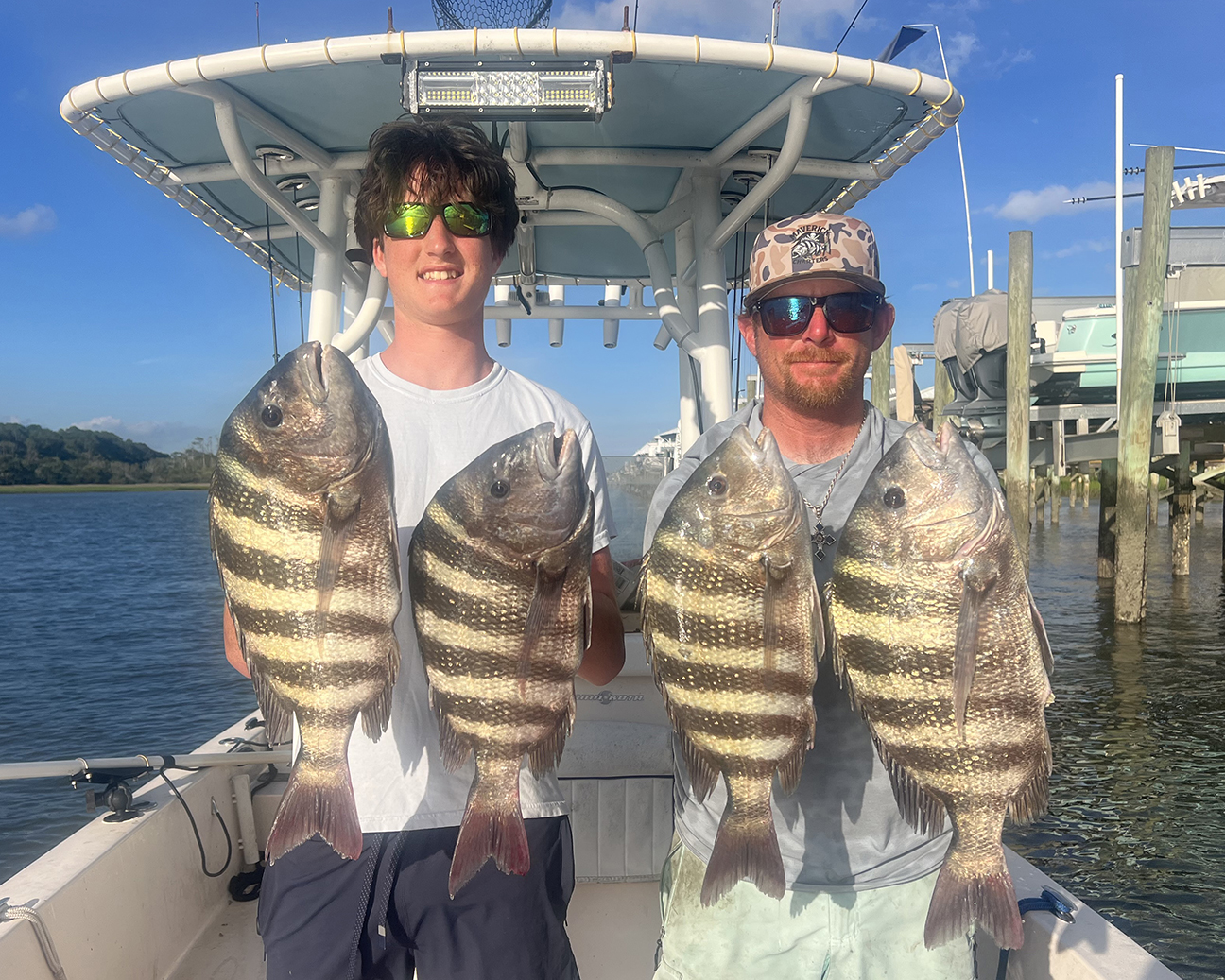
Ethan Hurley and Capt. Josh Reynolds, of Maverick Charters, with four of the sheepshead they caught pitching fiddler crabs hooked on 1/4 oz. jig heads under a dock in the Ocean Isle area.
While the fish on the screen weren’t as active as Josh would have liked, he did like the numbers of fish on this dock, and he really liked the numbers of big fish he saw. I was looking at sheepshead on a live scope for the first time, so I asked how he knew a big fish from a not big fish.
“I look at the pylon size,” he continued, “and the gaps in between the pilings, and compare them to the size of the fish marks. That’s how you can judge.”
When taking clients that have no experience trying to hook a sheepshead, as Josh does day in and day out, he starts with a lesson in soft hands, then moves to casting, and finishes with setting the hook.
Josh handed a medium-light trout rod to Ethan, my 14-year-old who has never been sheepshead fishing before, and told him to grab the rod like he usually does.
Josh gave some slight tugs on the line to mimic a subtle sheepshead bite and asked Ethan if he felt the tugs, which he hadn’t. Then he told Ethan to hold the rod loosely—let the rod rest on top of his fingers (without grabbing it) and lay his thumb on top of the rod. Josh repeated the slight tugs, and this time Ethan felt every one.
Next was Ethan’s lesson in pendulum casting. He was told to have 2-3 feet of line from the rod tip to the double-stacked fiddler crabs hooked to a light jig head and to get the rig swinging back and forth until feeling enough momentum to release the line and send it to the closest pylon.
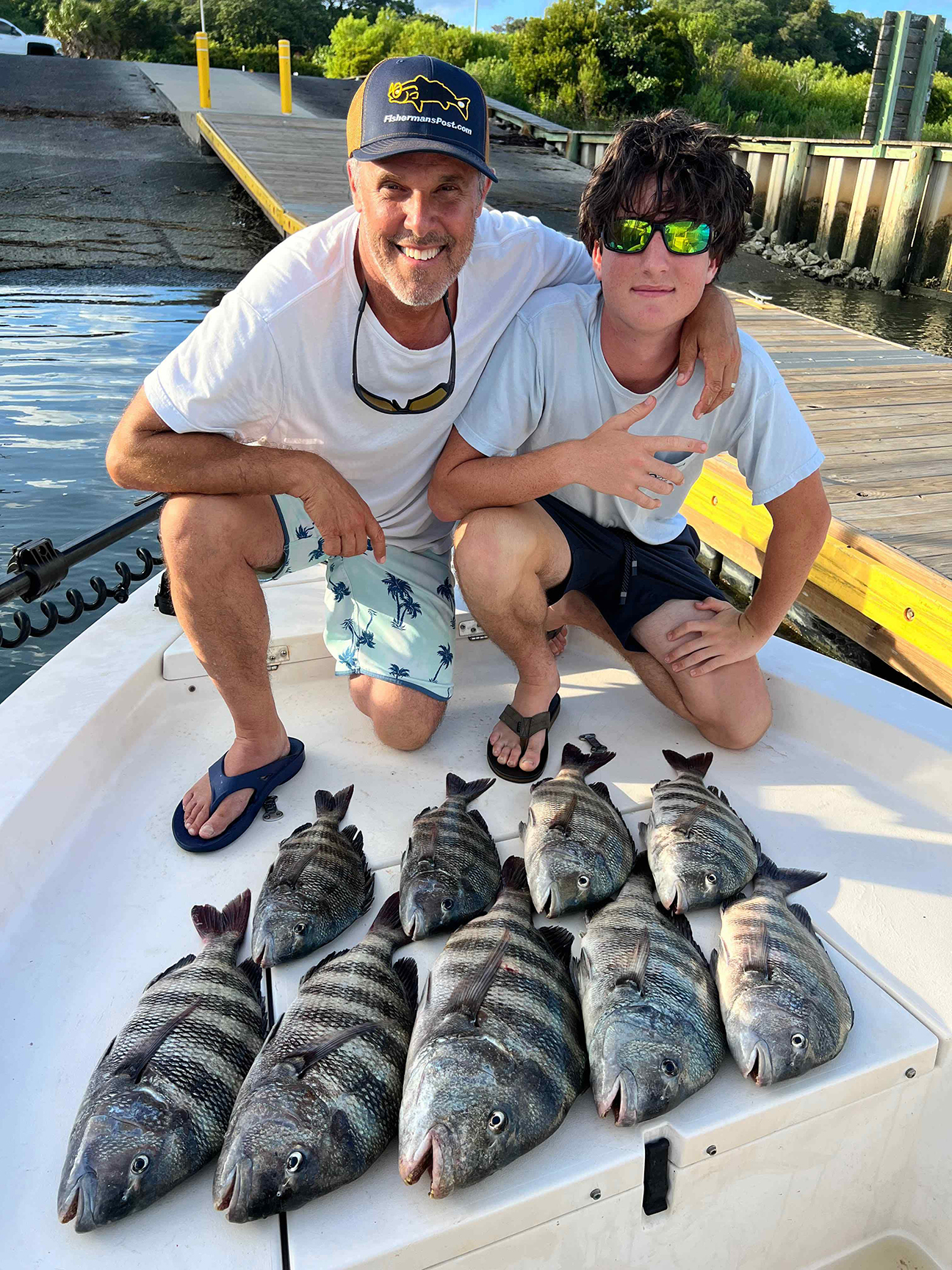
Gary and Ethan Hurley pose with sheepshead ranging in size from 4-10 pounds. They were bottom fishing a dock for sheepshead with Capt. Josh Reynolds of Maverick Charters out of Ocean Isle.
We weren’t vertically fishing for sheepshead. We were casting out to the poles and fishing the bottom, so there were more instructions for getting the bait to rest in the desired locations.
“Be sure not to drag the bait back to you. Let it sit,” he told Ethan as they stood in the bow of the boat positioned about 15-feet from the dock. “Most people drag the bait without realizing they’re doing it. They’re just trying to get slack up so they can feel tension. With these light jig heads, you’re probably not going to feel tension, and you want a little bit of bow in the line anyway.”
As for the bite and setting the hook, Josh explained that a sheepshead will swim up to the crab and then turn sideways to smash it. That crushing of the crab creates the taps he should expect.
Then as soon as the sheepshead gets the crab in its mouth, Josh continued, it quits swimming and drifts with the current for about 1/4-1/2 of a second. That 1/4-1/2 of a second is the steady pull you feel, and it’s also the quick and unforgiving window you have to set the hook or you’ve most likely missed the bite.
Ethan took a couple of tries to get the pendulum cast to the area just to the left and a little past the first pylon. He also needed a couple of tries to figure out how much line to let out after casting and before flipping the bail, as well as how much to reel in to get the desired amount of bow in the line without dragging the bait.
He lost some fiddlers by not setting the hook soon enough, and he lost other fiddlers even when he did everything right—sheepshead fishing means losing crabs no matter the experience level.
Then it all came together.
Ethan felt a vibration and a tap tap, followed by a little weight. He set the hook hard, per the captain’s instructions, and his rod bent over and danced under the pressure of what would be a 4-pound sheepshead, a fun accomplishment for an angler who first started fishing for sheepshead less than 20 minutes ago.
Ethan’s confidence grew, and he and I pulled out sheepshead ranging in size from 4-pounds (the smallest of the nine fish we caught) up to 10-pounds (my personal best), including an 8 and a couple of 7s.
If you have an interest in sheepshead fishing, then getting on a boat with Capt. Josh Reynolds of Maverick Charters should be on your to do list. Josh targets larger sheepshead from May through October, hopping from dock to dock to give you the best chances of a trophy fish (or two or three). He’s also been fine tuning the process of targeting nearshore sheepshead from January through March.
Whether you’re wanting to get someone their first sheepshead (like Ethan) or hoping to try and break double digits (like me), or maybe you simply want to see the live scope in action and expand your understanding of sheepshead and how to fish for them, Josh and his almost single-minded pursuit of sheepshead and only sheepshead is your guide.
You can look him up on Facebook or call him at (910) 477-3222, and if you’re really lucky, then his wife Christa, whom Josh is quick to give credit to for at least half of the strategies and techniques he employs on the boat, may join you and be the mate.
Most of his sheepshead trips are four-hours long, and I’m not good at math, but I’m good enough to know that there’s a lot of 1/4-1/2 seconds in four hours.
