
Tidelines – March 2026
While kids were enjoying the late January and early February strong snowfall along the North Carolina coast, our inshore fish species were not, especially speckled trout.
The cold stun event brought about the closure of speckled trout for both commercial and recreational anglers through June 30; however, redfish manage the cold better than speckled trout, so I joined Capt. Allen Jernigan, of Breadman Ventures Guide Service operating out of the Topsail area, to go and see how the red drum fishery was responding.
On our morning, the Topsail area had enjoyed about five days of non-freezing weather, and the water temperatures had warmed up from incredible lows of 35-36 degrees to a starting water temperature of 40-41 degrees (and by the end of the day we would see 47 degrees).
Since the snow and freeze, Allen had been checking on his usual winter locations to see the effects, and as expected, some spots had fish moving back in and some spots the fish just weren’t there. We were pulling away from the boat ramp around 7:45 and before the sun could warm things up, so Allen’s plan was to try deeper water locations where the black drum and red drum are both usually productive, even in really cold weather.
He handed me a rod with a piece of shrimp hooked on a lightly weighted Carolina rig and directed me to cast to a deeper hole up ahead that was right next to a flat.
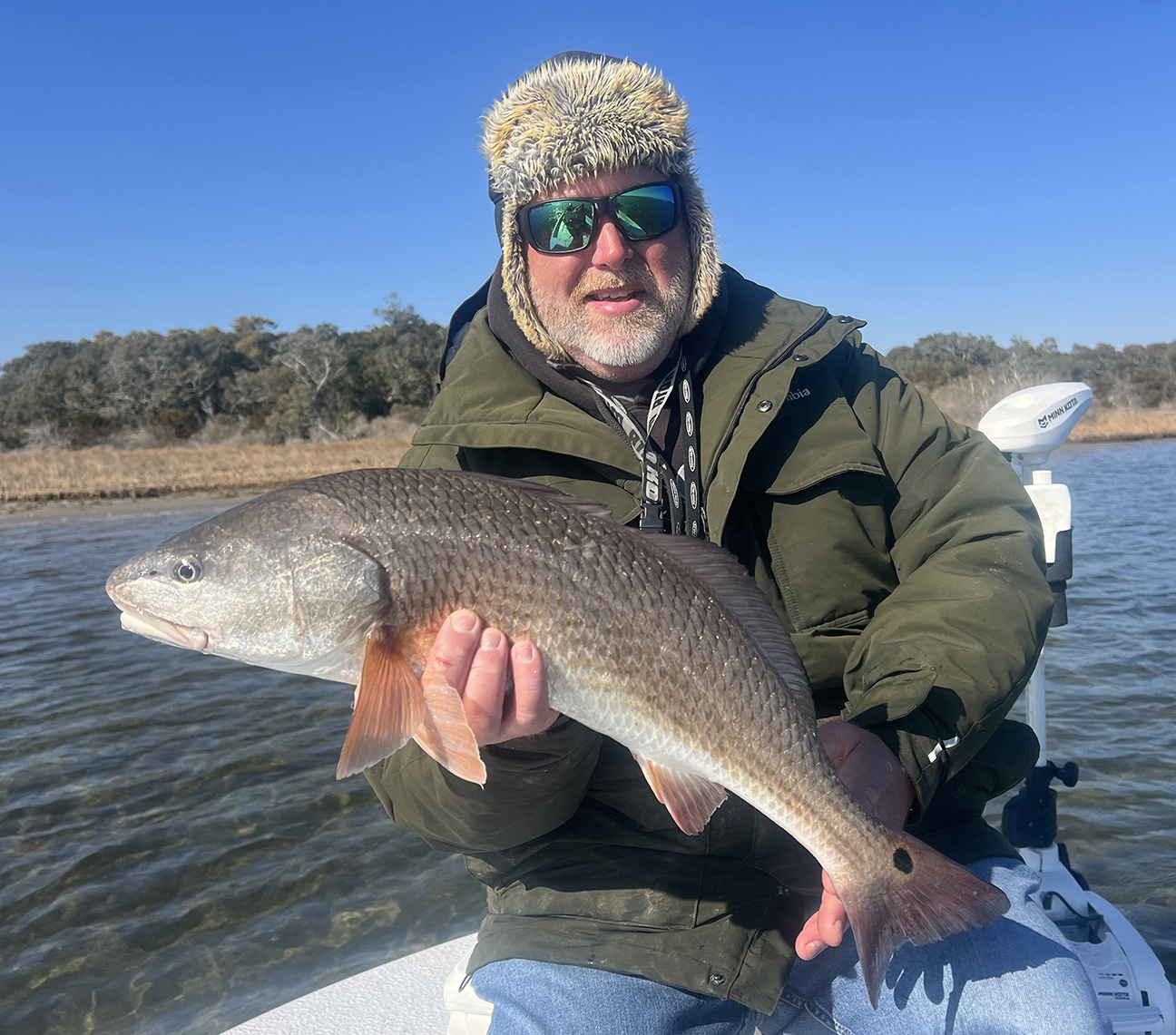
Capt. Allen Jernigan, of Breadman Ventures Guide Service, with an upper-slot redfish caught sight casting in a Topsail-area shallow bay with water temps in the mid-40s.
“There’s lots of dead fish out here,” Allen told me as he pointed to the white outline of a red drum on the bottom in about 6-feet of water. Most of the frozen fish we saw in this area were red drum and not trout, but the thought was that perhaps all the pelicans in the area had targeted the trout first.
Allen missed some bites near and under a dock, and while I believe I missed some near and under another dock, it’s hard for me to tell because the bites, as described by Allen, would only be a subtle pull.
We covered water and didn’t produce a fish, so Allen decided it was time for Plan B—target a shallow bay that had been regularly holding big schools of red drum prior to the cold stun event.
The near low tide meant that the majority of the bay was mostly 12-14 inches deep and the fish could be anywhere, so Allen put down the trolling motor and we began a zigzagging approach. While the water was clear, ripples on the water from the wind, combined with a winter sun that didn’t seem to be very bright even though there wasn’t a cloud in the sky, made visibility challenging.
We focused more on the bay’s scattered mounds (shallow oyster rocks) hoping that red drum may be sitting on them and getting some sunshine, but every mound was vacant. Suddenly, Allen pulled back on the trolling motor and told me to look out about 40 yards in the direction of 11:00.
“I saw a couple of single shadows, but at first I wasn’t sure it was fish because of the wind and wave action,” he explained as he flipped his bail and prepared to cast out a Saltwater Assassin 4-inch sea shad in the “Momma’s Chicken” color that had already been coated in the Blue Crab flavor of Pro-Cure. “Then as we got closer, it all came together. You can see the whole blackish and reddish color mass of fish that stretches out in a line about 50-60 yards long.”
I stood beside him, flipped my bail, too, and enjoyed the visual of hundreds of reds sitting motionless not far off our bow.
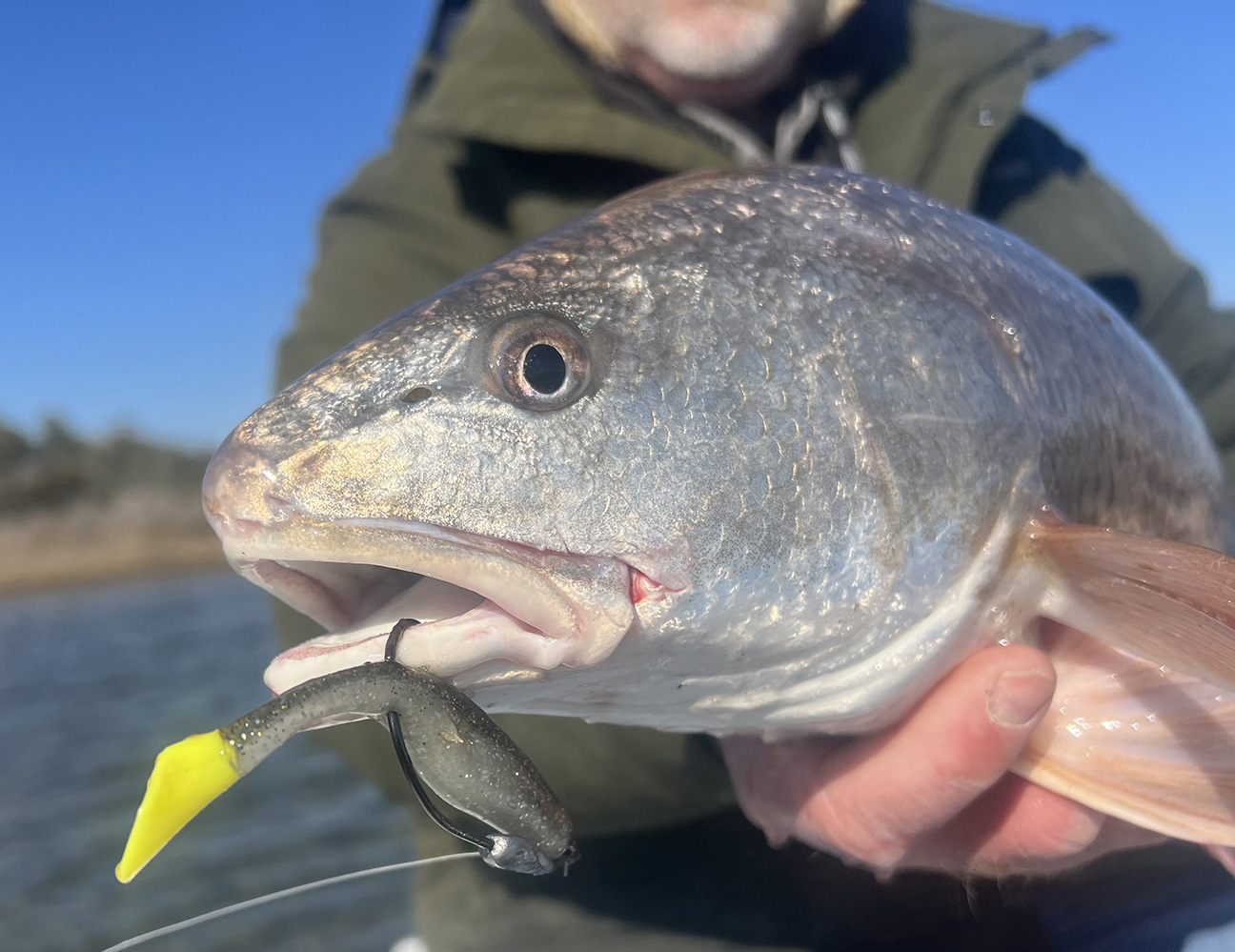
A Saltwater Assassin 4-inch sea shad in the “Momma’s Chicken” color hangs from the mouth of a redfish that Capt. Allen Jernigan pulled from a school of roughly 50 fish that were holding motionless in 14-inches of water.
“Try to throw just past them and bring your lure through them nice and easy and slow,” Allen continued. “You want little, small pop-pops and then let it sit on the bottom momentarily. Even cold, these redfish have thumped the plastics pretty good.”
Allen hooked up almost immediately, but my lure went too far past the school so that by the time I was in the zone, the school was already reacting to Allen’s hooked fish.
At first, Allen thought he had a lower-slot redfish, as the fight was a little sluggish, but at the boat we saw a 25-inch redfish come over the gunnel. The fish went in the livewell to take photos of later, and we turned to find the school again. Surprisingly, the slow-moving school had temporarily disappeared.
The rest of our day played out similarly. We would work hard to find a school, pull one out from the school, and then lose the school even though they were only meandering off.
“These fish are moving so slow they’re hard to find, especially with wind,” Allen told me. “They’re not pushing a head wake, there are no fins dimpling out of the water on the surface, none of the normal telltale stuff. They’re not stunned anymore. They’re just sitting motionless on the bottom in an effort to soak up some sunshine.”
Covering a lot of shallow, clear water also meant coming across more dead fish laying on the bottom. This bay had just a couple of trout, but we passed by a good number of dead red drum in varying sizes and even more flounder.
“When we have periods of cold, the flounder will go dormant and just lay in the mud. They’re still alive, but they don’t eat and just lay in the mud. They can lay there for weeks like that,” Allen shared, as flounder fishing and flounder gigging trips used to be a big part of his guide business. “All the ones we are seeing dead were in there laying dormant. Once it got too cold, iced over, and water temperatures dropped, they just literally froze.”
The story of my fishing day with Allen is much like the stories that are playing out up and down the North Carolina coast. Our fishery is a resilient one, albeit not a perfectly resilient one, but options to catch inshore fish always exist no matter the circumstances.
Capt. Allen Jernigan, of Breadman Ventures Guide Service out of the Topsail area, will mostly be targeting red and black drum in March and April, with red drum trips based predominantly on sight casting soft plastics and black drum trips focused on Carolina-rigging cut shrimp. While he focuses mostly on the Topsail and Sneads Ferry areas, he also travels over to the Neuse when better options (or perhaps just different options) are present in that body of water.
If you care about our local inshore fishery, you have choices. You can decide to stay off the water and leave the fish alone, or you can get on a boat with a guide like Allen, see and hook some fish in the gin-clear waters of winter, and in that firsthand experience, be better connected to and better understand the fishery.
You’ll also be helping out those inshore guides that could use a couple of bookings. There are fish to catch, and they would love the opportunity to show you.
