
Tidelines – November 2025
When lining up a fishing trip to write about for the November issue, I wanted a topic that would go along with the clear change of season we’ve had along the coast of North Carolina over the last two weeks of October, and I quickly felt that change-of-season sensation when I met Capt. Rosser Baxley, of the newly formed Cape Fear Inshore Charters, at the Downtown Wilmington boat ramp.
We had played around with the idea of targeting the Cape Fear River from Snows Cut and south, like he targets for the majority of the year, but when the river gets to 65 degrees and below, Rosser likes launching from Surry Street to capitalize on the healthy trout and striper bites that escalate with the cooler water temps, as well as the consistent red drum action that can be found basically year-round.
“The Cape Fear River has numerous places to fish, no matter the direction of the wind, and it’s not too open,” Rosser explained, “The creeks off the main river go on for miles. The potential is kinda limitless as far as areas to explore and find new bites.”
We headed past downtown and over to the Brunswick River, and I shared with him the thought I often have when I’m on these stretches of the river—from a fishing perspective, all of this water is intimidating.
“Yes, there’s lots of crazy tides, lots of current, and deep water,” he agreed, all while slowing down and turning towards a long grass bank on the Brunswick facing a creek on the opposite side. “If you don’t know how to keep your bait on the bottom properly, and if you don’t know how to fish your artificial in a natural action, then you might not be in a great position to catch.”
The other thought I often have when launching downtown is that just about every section of every bank looks fishy, so how do you decide when to fish and when to run past?
Rosser, who loves to instruct and teach on his boat (in addition to putting fish on the deck) explained, “These creeks right now are dumping out bait, and fish will find little banks where they can hunker down until they come across some of that bait.”
Rosser used his GPS Spot-Lock to hold position about 20’ off the bank, and he handed me a rod with a deep water, weedless fluke tied on. My instructions were to cast up current and bounce the bait back to the boat keeping parallel to the bank, and, hopefully, a striper or a red drum would cooperate.
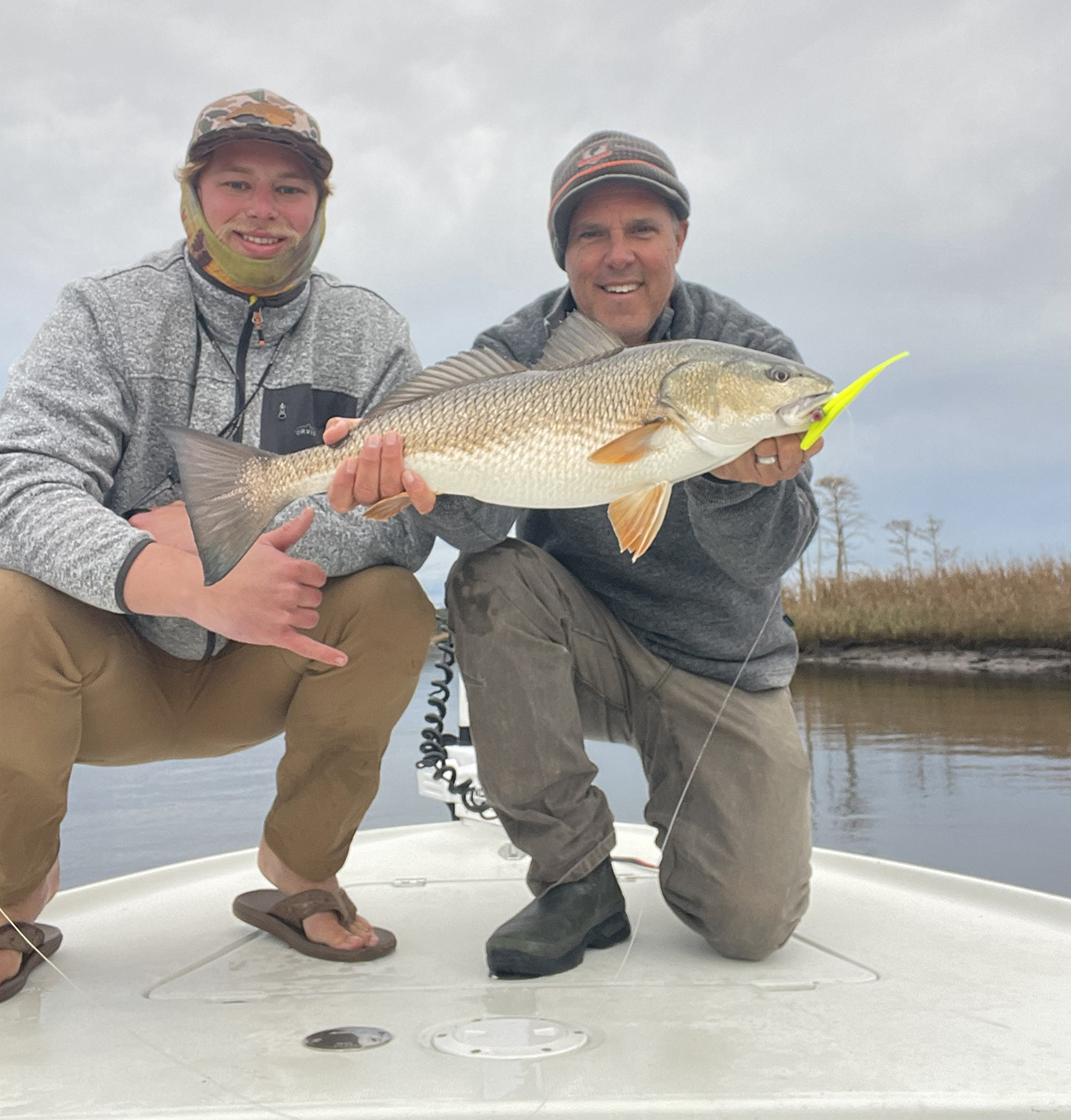
Capt. Rosser Baxley (left), of Cape Fear Inshore Charters, and Gary Hurley with one of the heavy slot red drum pulled off a grass bank in the Brunswick River. They were throwing weedless fluke soft plastics on jig heads in 8-12′ of water.
“This positioning helps keep the bait on the bottom, help keeps the slack out of the line, and helps with giving a nice, natural looking jigging action to the bait,” Rosser told me, and then added to wait 10 seconds after the cast and before retrieving the bait. His basic math is that my Z-Man Texas Eye 1/4 oz. jig head, tied on with a 20 lb. leader, would fall about one-foot per second, and we were targeting an area that varied from 8-12 feet deep.
For this type of fishing, Rosser further explained, you want to give the bait little hops—don’t overwork it—because he’s found that the best strategy is to use a “moving” dead stick presentation. Since these baits like to sit straight up and down on the bottom, you want to put more emphasis on the bait being on the bottom than the action itself.
I know it wasn’t on the first cast, but it was either the second or third when I counted to 10, gave my bait little bumps, kept a good connection with the bottom, and came tight to full-bellied, copper-colored, nearly over-slot red drum that used its strength, the current, and the deeper water to avoid the landing net for as long as possible.
We took our photos, released the fish, and then I put my bait in the same location where that first fish came from. The result was a second full-bellied, copper-colored, nearly over-slot red drum, and a third quick fish came in next, but the third fish came tight after I missed a bite.
“With the brackish and deep water, I think we have a lot of follows with our baits on the river,” Rosser commented. “You had a bite, missed it, kept the same slow presentation, and may have found a different fish, but I think the fish that missed your bait came back.”
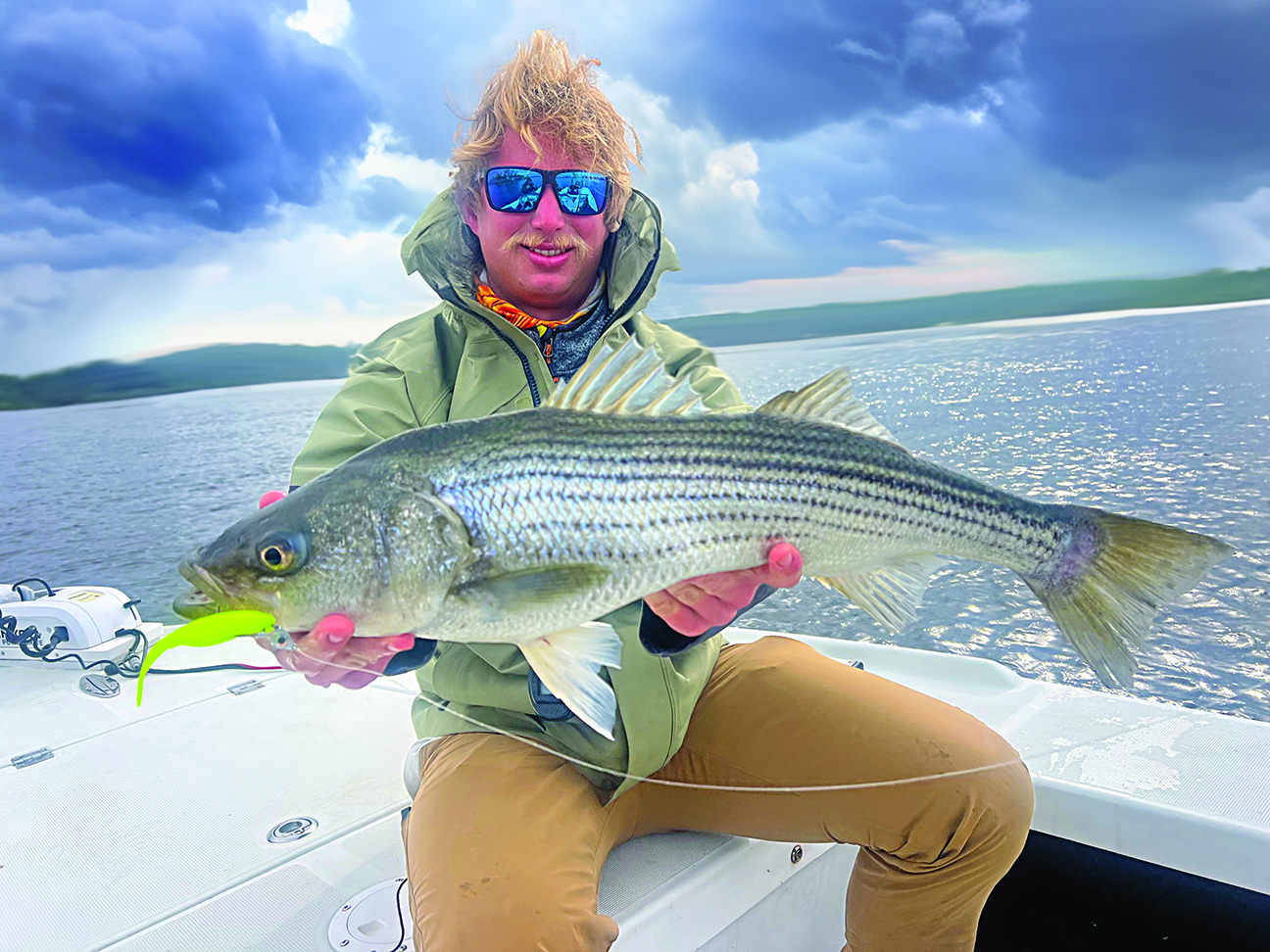
Capt. Rosser Baxley, of Cape Fear Inshore Charters, with a striper that was hooked while bouncing a soft plastic up a ledge in the Cape Fear River.
We were on fish, but we left the reds biting to pursue a River Slam—red drum, striper, and trout.
Rosser had some live shrimp, so we drifted one under a cork down a different grass line. The drift wasn’t quite right, with too much still water close to the bank where the desirable 4-5’ water depths were, so we called ourselves lucky for pulling in one modest speckled trout and set our sights on the striper part of the River Slam.
Rosser headed back in the direction of downtown to a “textbook ledge” he had found close to a bridge. The ledge had a 10’ depth change, was close to structure, and we would be throwing the same baits and employing the same retrieval method we were just using for the red drum. The stripers, Rosser predicted, would be sitting below the ledge, and we would be bouncing our baits through and over them.
While I quickly lost about 3-4 rigs by getting snagged on the bottom (welcome to river fishing), Rosser showed me what good things could happen when you’re not losing tackle—he brought in an estimated 5 lb. striper.
We took our photos, released the striper, celebrated the River Slam with a fist bump, and called the day a win.
If you’d like to experience the late fall and winter possibilities of red drum, trout, and striper that the Cape Fear River has to offer, then I suggest you reach out to the highly motivated Capt. Rosser Baxley, of Cape Fear Inshore Charters, at (910) 465-4080, or look him up on Instagram at @cape.fear.inshore.fishing (website coming soon). He’s just as passionate about fishing as he is about building his guide business, and that means you’ll get his A-game every time.
Or you can wait until the warmer weather of spring or summer and hit the southern part of the Cape Fear where he will be chasing red drum, trout, flounder, and more.
However, if you want to meet him in person, then go by the Porters Neck P.T.’s Olde Fashioned Grill owned by his dad Pete Baxley (who used to be a guide in the Wrightsville area a long, long, long time ago), where Rosser works part-time while building his client list. I think a burger, fries, and fresh lemonade is a great way to meet the guy who’s going to both put you on fish and help you become a better and more knowledgeable angler.
