
Tidelines – October 2025
The announcement earlier this year that there would be a two-week flounder season in North Carolina for recreational anglers was met by me, and most people I know, with some mixed emotions. While we were happy to hear that there would be a flounder season this year, feeling happy about getting just two weeks certainly didn’t seem like the correct response.
I have been trying over the last so many years to get on board with flounder as a sportfish, enjoying the pursuit, the bite, the hookset, and then the catch-and-release. I enjoy chasing many species in North Carolina without bringing any home, such as striper, albacore, and most red drum trips; however, any progress I made towards flounder as a sportfish was undone two years ago when I went flounder fishing out of South Carolina and brought home my five keeper fish, per SC regulations, including the biggest weighing in at about 5 pounds.
Putting keeper flounder in the cooler felt right, and bringing home fresh flounder fillets to cook for the family felt even more right.
On August 31, the eve of this year’s flounder season, I made sure I had a handful of rods rigged and ready to go for the morning and went down to our dock on Howe Creek at low tide to throw the cast net. For at least a week, the low tides weren’t really low tides, and since bait around our dock wasn’t being forced completely out of the grass and within comfortable reach of a cast net, it probably took about ten throws to gather a couple dozen finger mullet to have on hand for some early morning flounder fishing on Labor Day Monday.
Shortly after sunrise, I landed a couple of quick shorts and felt good about everything. Optimistically, a bag of ice was in a cooler nearby, along with a couple of baggies and a fillet knife, all waiting for the shorts to turn into a keeper fish.
To the right of our floating dock is a line of oyster rocks, and while slowly dragging a fresh live mullet down that line, I felt the telltale thud of a better flounder bite. This fish had weight, but about five yards off the dock, the fish spit the hook.

Leslie Hurley, fishing from the Hurley dock on Howe Creek, with the 25″ flounder she landed using a Gulp white jerk shad on Day One of the 2025 recreational flounder season.
With a fresh mullet, I made the exact same cast and the exact same retrieve, and on about the third cycle, I had a similar thud with similar weight. Unfortunately, this fish, too, gave up the hook, but two more casts later, the thud and weight came all the way to the dock and into the landing net.
My first keeper flounder of the 2025 recreational season, a 22” fish that I’ll estimate at 3-4 lbs., went into the cooler. I walked up to the house to find my youngest son Ethan awake, brought him down to the dock to take a couple of photos, and handed him a rod so he could try to catch his own keeper flatfish.
Our dock that day, and really all that first week, became an extended family affair. Brothers-in-law JJ (Day Two) and Tom (Day Ten) caught their keeper fish, as did nephew Daniel (Day Six), but the catch of Day One (and the 2025 season) for the Hurley dock came late in the afternoon from Leslie.
Since the live finger mullet had run out hours ago, my wife was trying to hook a flounder on live and cut pinfish, but decided to switch over to artificials to end the day. She fed a Gulp white jerk shad onto a Blue Water Candy jig head and targeted the left end of the floating dock.
The tide was basically flush high, with little to no water movement, but after just a handful of casts, she called out that she had a good fish on.
I was guilty, I admit. I was guilty of doubting whether or not she had a fish, and if she had a fish, was it really a “good” fish.
The line got closer, the bend in the rod stayed heavy, and then we both saw our dock’s doormat of the day—a 25” flattie that easily took the Boga grips to 6 lbs.
As everyone knows, though, a recreational flounder season is much more than fish weights.
For one, our dock was a community. On that first day and throughout the two weeks, we had friends and family come out to wet a line, some for just an hour and some for a long half day, so we got to come together and connect in ways that only happen with a flounder season.
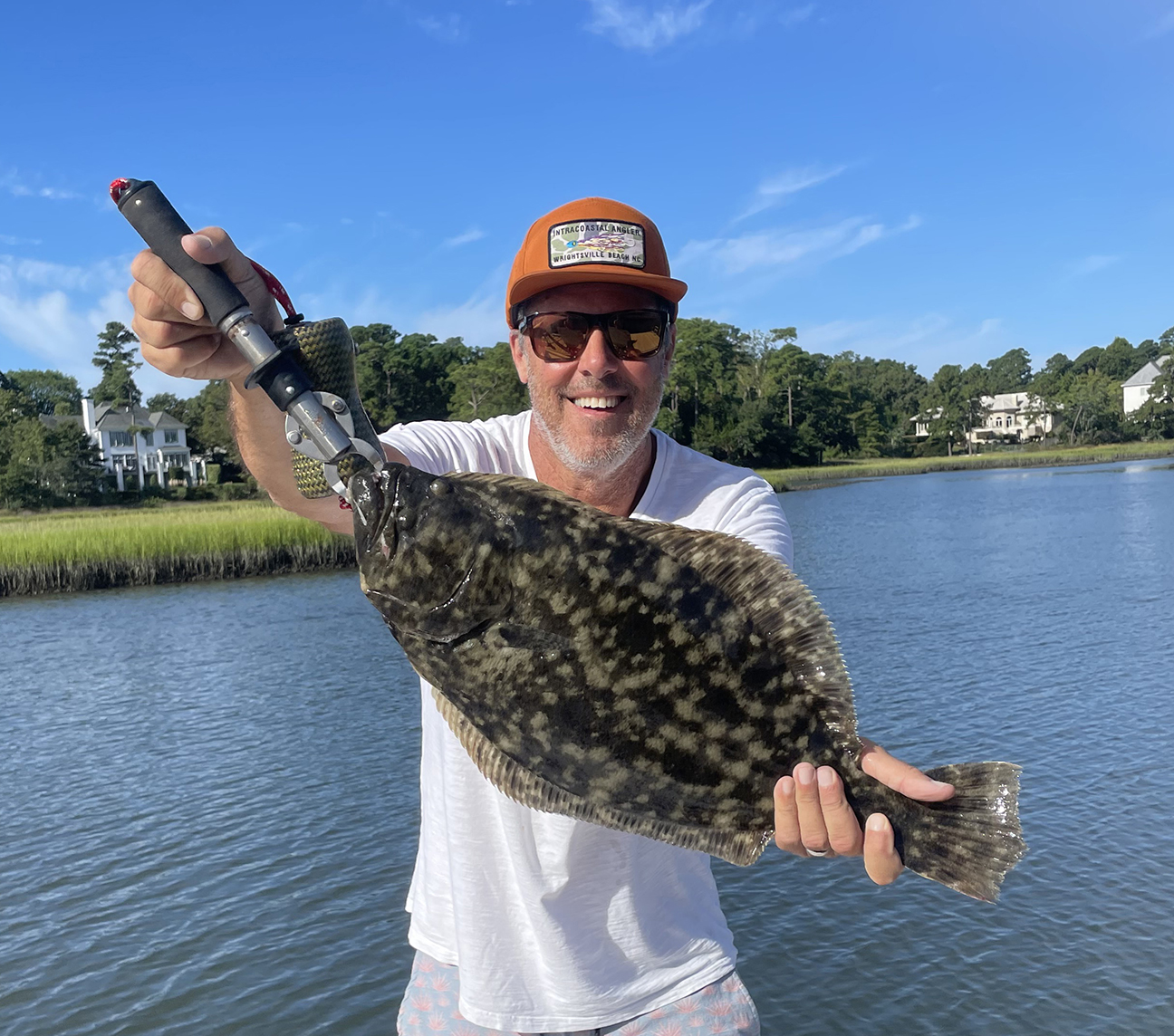
Gary Hurley with a 22″ flounder that fell for a live finger mullet on a Carolina rig. He was fishing from his dock in Howe Creek, as did many of his family and friends over the two week season.
For example, Daniel, my seven-year-old nephew, fast-forwarded a love of fishing when he baited his own hook, cast his own line, and brought in his own fish. His excitement turned into a trip to Intracoastal Angler where he traded in his “Zebco-style” setup for a true spinning combo that he could grow into, and while there, his dad decided not to fix the broken guides on his current rod but to go ahead and spend the money on a new Fenwick.
My wife Leslie and I, with two heavy fish brought in on day one, hosted a fish fry that evening. In addition to her sister Mira and family, we also fed two friends and celebrated much later into a Monday night than normal.
To further highlight the ripple effect of a flounder season, I could also talk about Fisherman’s Post modifying the Carolina Beach Inshore Challenge to a split leaderboard of flounder and red drum and the subsequent gas, tackle, ice, and supplies that just our one event generated, and there was certainly more than one flounder competition over those two weeks doing the same.
Catching and keeping keeper flounder in North Carolina, even if only for two weeks, felt way more right than that South Carolina trip I mentioned at the start of this article.
On the night before the flounder season ended, my wife and I did a boat date to The Sailfish at Marsh Creek Marine, and on the ride home, I got sentimental. Though it was a windy night with almost complete cloud cover, I noticed the ICW and creek shorelines dotted by boats with bright lights pointing down into the water in an attempt to gig their last flounder of 2025. The sight of giggers near the end of the two weeks brought back those mixed emotions—happy to see such a familiar sight that I didn’t even know I had missed, and sad that such a familiar sight was so fleeting.
I hope everyone in the NC saltwater fishing community has a story to tell, and maybe even a photo to share, about this year’s flounder season. I also hope that something that feels so right finds a path to last for way more than two weeks.
